Thursday, May 09, 2013


Wednesday, May 08, 2013
Monday, May 06, 2013
Monday, April 29, 2013
Thursday, April 25, 2013
Tuesday, April 23, 2013
Friday, April 19, 2013
Thursday, April 18, 2013
Wednesday, April 17, 2013
Financial Guest Blogger
opportunity for financial writers and financial guest bloggers to get exposure and back links from well-known site
http://www.onlywire.com/r/122251317Friday, April 12, 2013
Monday, April 08, 2013
Sunday, April 07, 2013
Saturday, April 06, 2013
Friday, April 05, 2013
Tuesday, April 02, 2013
Saturday, March 30, 2013
Friday, March 29, 2013
Thursday, March 28, 2013
Wednesday, March 27, 2013
Tuesday, March 26, 2013
Monday, March 25, 2013
Sunday, March 24, 2013
Saturday, March 23, 2013
Friday, March 22, 2013
Thursday, March 21, 2013
Wednesday, March 20, 2013
Tuesday, March 19, 2013
Monday, March 18, 2013
Sunday, March 17, 2013
Saturday, March 16, 2013
Friday, March 15, 2013
Credit Report Errors--The Ultimate Fix for the Frustrated
The typical advice to contact creditor bureaus does not work for millions and that is the problem. The credit bureaus simply report what the creditors tell them to report. When a consumer complains, the bureaus simply confirm the same incorrect information with the creditors. And millions of consumers get stuck at this point, having no leverage to get the creditors to fix errors. 60 Minutes showed how their reporter, Steve Croft, got nowhere using the typical, ineffective advice to write the credit bureaus. Here is a solution that works and how I got AMEX and Citicorp to change their errors after they refused. The leverage is with the creditors and using small claims court gets their attention every time and is very inexpensive: http://disputeyourcreditreport.us/ebook
http://www.onlywire.com/r/120307077Thursday, March 14, 2013
Wednesday, March 13, 2013
Tuesday, March 12, 2013
Monday, March 11, 2013
Saturday, March 09, 2013
Tuesday, March 05, 2013
Sunday, March 03, 2013
Thursday, February 28, 2013
Wednesday, February 27, 2013
Tuesday, February 26, 2013
Monday, February 25, 2013
Sunday, February 24, 2013
Friday, February 22, 2013
Wednesday, February 20, 2013
Monday, February 18, 2013
Sunday, February 17, 2013
Saturday, February 16, 2013
Friday, February 15, 2013
Thursday, February 14, 2013
Wednesday, February 13, 2013
Sunday, February 10, 2013
Saturday, February 09, 2013
Friday, February 08, 2013
Thursday, February 07, 2013
Tuesday, February 05, 2013
Sunday, February 03, 2013
Saturday, February 02, 2013
Friday, February 01, 2013
Thursday, January 31, 2013
Wednesday, January 30, 2013
Tuesday, January 29, 2013
Monday, January 28, 2013
Saturday, January 26, 2013
Friday, January 25, 2013
Thursday, January 24, 2013
Wednesday, January 23, 2013
Tuesday, January 22, 2013
Monday, January 21, 2013
Sunday, January 20, 2013
Saturday, January 19, 2013
Friday, January 18, 2013
Wednesday, April 25, 2012
If you want to be considered a financial specialist (or any professional), you better introduce ideas to your clients along with potential customers which they do not know. Being a resource of information is the primary strategy to obtain trustworthiness by appearing knowledgeable. It's not that you need to know something that everyone else does not. Since you study journals that the general public does not read (or else you better be if you're truly a professional), you know about issues two to three months ahead of the very same issues appear in your daily newspaper. These will be the sorts of subject areas that ought to be in your financial planning newsletter.
In the event you want referrals, your clients need to trust you. Believe it or not, several clients have completed transactions with you yet do not have 100% trust in you. In order to develop that confidence in to the hundred percent level, you need a regular flow of interaction that increases your credibility. A monthly financial advisor e-zine will do exactly that. Your customers will certainly recognize that you're as wise as they previously believed you might be.
Why don't you consider dozens of potential customers you have talked to as well as met, those who never purchased anything at all? Do you think they're going to all of a sudden think about you, find your business card as well as call you the moment they have cash in their pants pocket? Improbable. (Would they still have your business card)? The individual that will probably win their business is the person who is in front of their face at the same moment they have a desire to act. You might be that person if you deliver your e-newsletter every 30 days because you will then have their "share of mind."
Are you sure your customers realize all of the services you offer? Take a poll and you'll be amazed. In fact, your customers might currently buy items and services that you offer somewhere else given that they don't recognize you offer these things. In your own e-newsletter, you are able to present these products along with services you know about and provide by providing informative and never sales oriented posts. Needless to say, in a very good e-newsletter, the end of each article will make a proposal that urges your reader to act without making a sales pitch.
People say that in issues of love, absence makes the heart grow fonder. In business, it's just the other way. In your absence, clients forget about you. If you want clients to recommend you and provide their new business to you, you must be in regular contact and a easy way to do that is using the silent salesman known as your month to month newsletter.
Thursday, November 02, 2006
Can You Count On Dividend Income?
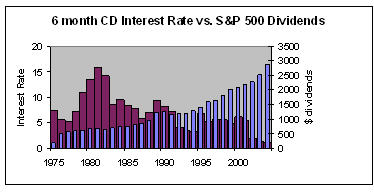
First, create a diversified portfolio of different dividend-paying stocks. If your dividends are coming from a single source, you run the risk losing what could be a significant portion of your income should the company decide to discontinue their dividend payments. With a diversified portfolio, your regular dividend income stream could continue, buffered by the on-going payments of the other stocks in your portfolio. Although diversification does not guarantee against the risk of loss in a declining market, it can help to reduce the market volatility risk of your overall portfolio.
Second, when building your dividend-income portfolio, look for high-quality companies in sectors that have historically paid out a steady stream of dividends to shareholders. Finding these stocks can be tricky, but there are a few good places to start. Companies in stable industries or in highly-regulated markets such as electric utilities are typically good candidates for a dividend-income portfolio. These companies usually face fewer threats to their business and fewer interruptions of their cash flow, making it less likely that they would have to discontinue dividend payments.
The Dow Dividend Strategy has been a very good way to mechnically select stocks with sustainable dividends, growth in dividends and growth of capital. When you compare what history has shown regarding growth of dividend income vs. the reliability of fixed income investments (chart below) for income over the long run, the asset allocation decision is simple.
Sunday, October 22, 2006
A Steady Income with Tax-deferred Growth
An immediate annuity will pay you a predictable amount of money each month for a fixed term (or lifetime). Part of your income would be tax-free since it is a return of your investment. Once you make the investment the funds are generally not accessible. On the other hand, a fixed annuity?s income accumulates tax-deferred. And you can withdraw the earnings and a certain percentage of the principal (depending on the issuing company?s guidelines) each year.
The concept of the split-annuity is that by the time your immediate annuity?s term runs out, and the payments stop, your fixed annuity will have grown enough to replace your original investment. Then you can start the process over again at the current interest rates, which could be higher or lower than your prior investment?s.
The calculation to determine what portion of your split-annuity should go into the immediate annuity will depend on the current interest rates and the number of years for the payouts.
Certified Retirement Financial Advsior graduates have offered to provide no cost illustrations of the split annuity.
Thursday, October 19, 2006
A 0% Capital Gains Tax Could be in Your Future
These rates will remain effective through 2007. In 2008, however, another
change emerges when the capital gains tax falls to 0% for individuals in the 10%-
15% brackets. This presents some money saving opportunities for you if you are
considering giving assets to anyone in a lower tax bracket, such as children or
grandchildren.
For example, suppose you own a mutual fund that you want to use to help
your grandson when he starts college in 2008. If you are in a high tax bracket,
you will have to pay 15% on any gains that you realize on the fund?s sale.
The IRS specifies that when you give an appreciated asset, the donee
receives the gift at your cost basis. Therefore, any untaxed profit is passed on
with the asset and taxed based on the donee?s tax bracket when sold. So if your
grandson sells any of the gifted shares between now and the end of 2007, he will
have to pay at least 5% on the profits.
On the other hand, you could hold off
giving him the fund until 2007 and have him keep the account for at least one
year. As long as he liquidates the fund in 2008, he will have a good chance of
avoiding the capital gains tax. However, based on present law, if he does not
sell out until 2009, he could face a 10% capital gains tax.
Wednesday, October 04, 2006
Questions to ask a Retirement Planner
The needs of people in retirement or about to retiree are different than those of baby boomers. Yet all you see in articles is advice for baby boomers on how to prepare for retirement. What about help for those age 60+ who have already cashed in their chips or about to do so?
Good news. There has been increased education, albeit slowly, for financial advisors to help people in retirement. But be careful about the several designations you may see.
The most widely held senior designation, Certified Senior Advisor (CSA) is not a financial training at all. Although many financial professionals gain this designation, so do nurses, gerontologists, funeral home directors and others dealing with older people. The designation is really a training in communication skills and issues of aging and not in financial issues.
The Certified Retirement Financial Advisor designation (CRFA) is ONLY for financial professionals that have at least 2 years experience in financial services. The enrollees seek to polish their retiree-specific financial knowledge and the course covers every aspect of financial concerns to someone in their retirement years: how to avoid tax on social security income, how to liquidate assets for the lowest or zero capital gains tax, how to utilize section 72 rules for early retirees who need to tap their retirement funds before age 59 ½, IRS sections 1035 and 1031 exchanges for tax deferral, Roth IRA conversions, how to minimize taxes on IRA distributions, how to build retiree portfolios for greater secure income, how to create low risk equity portfolios, training in estate planning and asset protection, long term care planning and related tax issues, trusts, advance directives, integration of your retirement plan and estate plan, asset titling issues, beneficiary selection for retirement accounts and other assets. Fifteen hours of continuing education is required annually to maintain the designation.
The other legitimate designation is Chartered Advisor for Senior Living (CASL). However, of the 5 courses that graduates must complete, 2 of them are general and not retiree specific. Fifteen hours of continuing education is required every 2 years to maintain the designation.
Be cautious of any other designations held by a financial advisor who contends that the designation has prepared him to give appropriate financial advice for people in retirement. There are several designations that have no substance and are programs designed to make a financial sales person look like a professional.
Here are some simple questions you can ask a retirement planner. If the professional cannot answer them easily, then move on:
How can IRS section 1031 help me (it helps people divest real estate without current taxation)
What is the lowest possible rate on capital gains that I could possibly qualify for (5% currently, 0% starting in 2008)
Can anyone convert their IRA to a Roth IRA (their modified adjusted gross income must be under $100,000 currently)
If I want to leave my IRA to my 3 children, do I need to split it into 3 accounts (no, the children can split the IRA after your death into 3 accounts)
Will a living trust help me save taxes (no?the benefits of a living trust that cannot be accomplished otherwise is the avoidance of probate and privacy)
What?s the difference between an annuitant driven and owner driven annuity (all annuities are owner driven?if the owner dies, the owners beneficiary gets the proceeds)
Can I lose money with an equity indexed annuity (yes, if you withdraw funds during the surrender period, the surrender charge could be larger than anything you have earned resulting in a loss)
Why shouldn?t I put my sons name on my accounts as joint tenant so he inherits them directly if I die (you can be deemed to have given a gift which may have tax consequences and you have exposed jointly held assets to your son?s creditors).
To find a retirement planner that has studied all of these issues and much more visit Retirement Planner.

