Thursday, January 31, 2013


Wednesday, January 30, 2013
Tuesday, January 29, 2013
Monday, January 28, 2013
Saturday, January 26, 2013
Friday, January 25, 2013
Thursday, January 24, 2013
Wednesday, January 23, 2013
Tuesday, January 22, 2013
Monday, January 21, 2013
Sunday, January 20, 2013
Saturday, January 19, 2013
Friday, January 18, 2013
Wednesday, April 25, 2012
Five Methods to Make Money with a newsletter for your Clients and also Prospective Clients
If you want to be considered a financial specialist (or any professional), you better introduce ideas to your clients along with potential customers which they do not know. Being a resource of information is the primary strategy to obtain trustworthiness by appearing knowledgeable. It's not that you need to know something that everyone else does not. Since you study journals that the general public does not read (or else you better be if you're truly a professional), you know about issues two to three months ahead of the very same issues appear in your daily newspaper. These will be the sorts of subject areas that ought to be in your financial planning newsletter.
In the event you want referrals, your clients need to trust you. Believe it or not, several clients have completed transactions with you yet do not have 100% trust in you. In order to develop that confidence in to the hundred percent level, you need a regular flow of interaction that increases your credibility. A monthly financial advisor e-zine will do exactly that. Your customers will certainly recognize that you're as wise as they previously believed you might be.
Why don't you consider dozens of potential customers you have talked to as well as met, those who never purchased anything at all? Do you think they're going to all of a sudden think about you, find your business card as well as call you the moment they have cash in their pants pocket? Improbable. (Would they still have your business card)? The individual that will probably win their business is the person who is in front of their face at the same moment they have a desire to act. You might be that person if you deliver your e-newsletter every 30 days because you will then have their "share of mind."
Are you sure your customers realize all of the services you offer? Take a poll and you'll be amazed. In fact, your customers might currently buy items and services that you offer somewhere else given that they don't recognize you offer these things. In your own e-newsletter, you are able to present these products along with services you know about and provide by providing informative and never sales oriented posts. Needless to say, in a very good e-newsletter, the end of each article will make a proposal that urges your reader to act without making a sales pitch.
People say that in issues of love, absence makes the heart grow fonder. In business, it's just the other way. In your absence, clients forget about you. If you want clients to recommend you and provide their new business to you, you must be in regular contact and a easy way to do that is using the silent salesman known as your month to month newsletter.
If you want to be considered a financial specialist (or any professional), you better introduce ideas to your clients along with potential customers which they do not know. Being a resource of information is the primary strategy to obtain trustworthiness by appearing knowledgeable. It's not that you need to know something that everyone else does not. Since you study journals that the general public does not read (or else you better be if you're truly a professional), you know about issues two to three months ahead of the very same issues appear in your daily newspaper. These will be the sorts of subject areas that ought to be in your financial planning newsletter.
In the event you want referrals, your clients need to trust you. Believe it or not, several clients have completed transactions with you yet do not have 100% trust in you. In order to develop that confidence in to the hundred percent level, you need a regular flow of interaction that increases your credibility. A monthly financial advisor e-zine will do exactly that. Your customers will certainly recognize that you're as wise as they previously believed you might be.
Why don't you consider dozens of potential customers you have talked to as well as met, those who never purchased anything at all? Do you think they're going to all of a sudden think about you, find your business card as well as call you the moment they have cash in their pants pocket? Improbable. (Would they still have your business card)? The individual that will probably win their business is the person who is in front of their face at the same moment they have a desire to act. You might be that person if you deliver your e-newsletter every 30 days because you will then have their "share of mind."
Are you sure your customers realize all of the services you offer? Take a poll and you'll be amazed. In fact, your customers might currently buy items and services that you offer somewhere else given that they don't recognize you offer these things. In your own e-newsletter, you are able to present these products along with services you know about and provide by providing informative and never sales oriented posts. Needless to say, in a very good e-newsletter, the end of each article will make a proposal that urges your reader to act without making a sales pitch.
People say that in issues of love, absence makes the heart grow fonder. In business, it's just the other way. In your absence, clients forget about you. If you want clients to recommend you and provide their new business to you, you must be in regular contact and a easy way to do that is using the silent salesman known as your month to month newsletter.
Thursday, November 02, 2006
Can You Count On Dividend Income?
One of the challenges many older investors face when managing their cash flow pertains to income from dividends. Unfortunately, common stock dividends come with no guarantees. Companies are not required to pay them, and those that do can suspend their dividends at any time as their business needs dictate. Since there are no guarantees for dividends, should you rely on them for planning even a portion of your retirement income? The answer is yes.

First, create a diversified portfolio of different dividend-paying stocks. If your dividends are coming from a single source, you run the risk losing what could be a significant portion of your income should the company decide to discontinue their dividend payments. With a diversified portfolio, your regular dividend income stream could continue, buffered by the on-going payments of the other stocks in your portfolio. Although diversification does not guarantee against the risk of loss in a declining market, it can help to reduce the market volatility risk of your overall portfolio.
Second, when building your dividend-income portfolio, look for high-quality companies in sectors that have historically paid out a steady stream of dividends to shareholders. Finding these stocks can be tricky, but there are a few good places to start. Companies in stable industries or in highly-regulated markets such as electric utilities are typically good candidates for a dividend-income portfolio. These companies usually face fewer threats to their business and fewer interruptions of their cash flow, making it less likely that they would have to discontinue dividend payments.
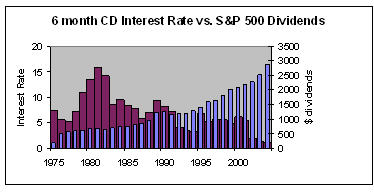
The Dow Dividend Strategy has been a very good way to mechnically select stocks with sustainable dividends, growth in dividends and growth of capital. When you compare what history has shown regarding growth of dividend income vs. the reliability of fixed income investments (chart below) for income over the long run, the asset allocation decision is simple.
First, create a diversified portfolio of different dividend-paying stocks. If your dividends are coming from a single source, you run the risk losing what could be a significant portion of your income should the company decide to discontinue their dividend payments. With a diversified portfolio, your regular dividend income stream could continue, buffered by the on-going payments of the other stocks in your portfolio. Although diversification does not guarantee against the risk of loss in a declining market, it can help to reduce the market volatility risk of your overall portfolio.
Second, when building your dividend-income portfolio, look for high-quality companies in sectors that have historically paid out a steady stream of dividends to shareholders. Finding these stocks can be tricky, but there are a few good places to start. Companies in stable industries or in highly-regulated markets such as electric utilities are typically good candidates for a dividend-income portfolio. These companies usually face fewer threats to their business and fewer interruptions of their cash flow, making it less likely that they would have to discontinue dividend payments.
The Dow Dividend Strategy has been a very good way to mechnically select stocks with sustainable dividends, growth in dividends and growth of capital. When you compare what history has shown regarding growth of dividend income vs. the reliability of fixed income investments (chart below) for income over the long run, the asset allocation decision is simple.
Subscribe to:
Posts (Atom)

